Astech

    Smarter Automation, Seamless Integration
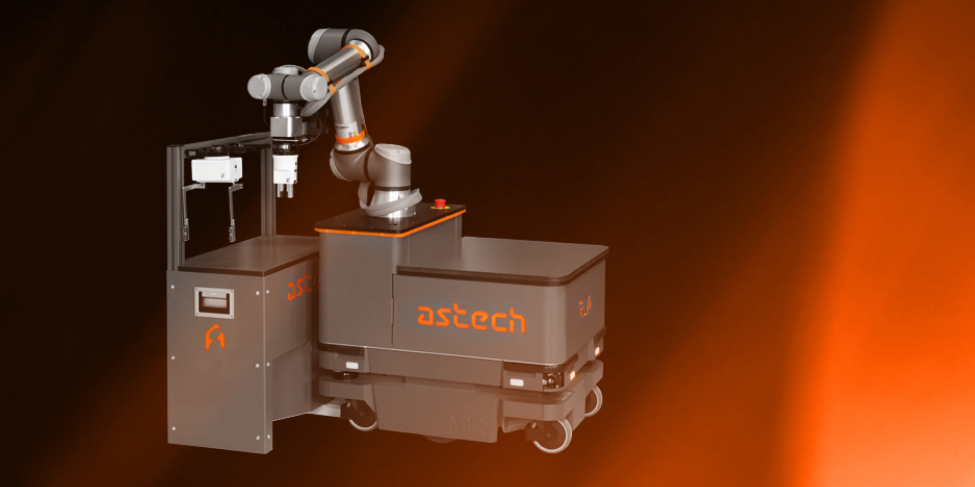
    Astech has a number of high-speed Robot and AMR solutions that utilise the latest in robotic innovation and tried and tested technologies. We can integrate your chosen manufacturer with your existing production software and infrastructure to create a collaborative robots solution that fits seamlessly.

    Collaborative Arms

    Robots have traditionally been enclosed or within safety perimeters, however newer robotic arms are collaborative. This means people can work alongside them to increase production quality, breaking free from fixed, single process robotics and becoming mobile. There are sensors and safety features to prevent the collaborative robotic arms from advancing if someone comes into contact with them or enters the workspace.

    Benefits

    Collaborative Robots (COBOTS)

    Cobots are designed to assist human workers. They offer improved productivity, efficiency and quality, are more adaptable and can be easily redeployed – a distinct advantage over traditional robot automation. The main benefit cobots offer is operating alongside workers in the same workspace. Cobots tend to be smaller and slower than traditional automation or robotics, and with less reach and force, but thanks to advances in sensor technology and data processing, which enable safety features that allow collaborative working, they can operate without barriers or enclosures.

    Astech’s mobile robots are engineered to seamlessly integrate into dynamic laboratory environments, offering unparalleled flexibility and efficiency. Designed with advanced navigation capabilities, these robots autonomously traverse complex spaces, including ramps, elevators, and confined areas. This adaptability ensures your laboratory operations remain uninterrupted, even in challenging layouts. By automating routine tasks, Astech's mobile robots free up valuable human resources, allowing your team to focus on more critical, value-added activities.


    Tailored Solutions for Diverse Laboratory Needs


    Understanding that each laboratory has unique requirements, Astech offers mobile robots customised to meet specific operational needs. Whether it's the Robotic Lab Assistant (RLA) series or other specialised solutions, Astech ensures each robot is equipped with the necessary tools and software to integrate smoothly into your existing infrastructure. This bespoke approach guarantees your laboratory benefits from a solution that not only fits but enhances your workflow, driving productivity and innovation.

    What are Collaborative Robots?

    To the question ‘what are cobots (collaborative robots)’, these are defined as specialised, industrial robots designed to operate safely next to human workers in a shared workspace. Their popularity has soared in the past decade and Astech delivers a number of advanced cobot applications in manufacturing and industrial environments. Unlike traditional robots that are typically enclosed or within safety perimeters, cobots use advanced sensors and lightweight materials to collaborate with humans in the same space without the need for physical barriers. At Astech, we help laboratories, manufacturers, pharmaceutical settings and more introduce Cobots into their workflows to improve efficiency and accuracy across critical processes. They tend to have a smaller footprint than traditional machines. They are best suited to repetitive and physically demanding exercises, freeing up time and resources for technicians, engineers, and laboratory workers to focus on tasks that require more human insight.

    Key Cobot features

    Different manufacturers will have varying features included within their Cobot builds that can be adjusted depending on what they are needed for. The following features are the most notable of Astech’s RAMP (Cobots) to give you an idea of what is possible.
    • A safety-centric design - greater safety is one of the most desirable features of Cobots, making them a sought-after investment. Ramp Cobots have advanced sensors and controls to keep human operators out of harm's way

    • Optimal workflow and productivity features - Cobots make it possible to enhance workflows and reduce error margins for greater throughput

    • Seamless integration - Cobots are designed to seamlessly integrate into any workflow, no matter how complex or specialised

    • Intuitive and user-friendly - they have user-friendly interfaces to allow workers to easily interact with them

    • Varied applications and flexibility - they can be adapted to different tasks depending on where they are needed most, making them a long-term, sustainable investment that changes in cohesion with their environments

    Collaborative Robots in Manufacturing and Industry Applications

    Industries using cobot applications in manufacturing see significantly fewer workplace injuries. Collaborative industrial robots can take on assembly, dispensing, welding, material removal and quality inspection jobs, to name a few. They can easily lift and transport materials in the workplace, removing material handling, one of the riskiest jobs in manufacturing, from human workers and are perfectly used supporting monotonous tasks that give rise to repetitive strain injury; tedious assembly jobs; and heavy duty machine tending tasks. Cobots are adaptable enough to work across any industry and can flex to meet your specific requirements.

    Robotic Arms and Automated Production

    Collaborative robotic arms are common in many industries as well-established components of automated production facilities. Fixed robotic arms tend to perform a limited number of tasks and are dedicated to a single part of a production or manufacturing process. Automation can improve safety, quality and increase productivity but advantages are only seen when the right automation and robotic solution is adopted. Astech can help you assess what combinations of traditional automation, robotics and collaborative technology will provide the best solution for your manufacturing needs. The many benefits they offer include:
    • Performing repetitive tasks consistently and at speed

    • Lifting heavy loads or dangerous materials

    • Deployment in challenging or controlled environments

    Mobilising Cobots with Autonomous Mobile Robots (AMRs)

    For ultimate flexibility, our collaborative robot applications can be mounted onto mobile bases enabling them to multi-task across locations and to be repositioned quickly. These bases might be as simple as a trolley or, alternatively, an autonomous mobile robot (AMR). Astech mobilises cobots in busy or evolving environments where constant redeployment of mobile robotics is preferable. It allows collaborative robotics to assist in the workplace with minimal infrastructure changes, navigating safely around busy spaces.

    Cobot types as determined by the ISO 10218 standard

    Collaborative robots are leading the way to creating cohesively collaborative workflows between industrial robots and humans, making safer, highly efficient work spaces that have a significantly better output. Cobot types are dictated by the ISO 10218 standard, which is an international standard developed in 2011 that focuses on the safety of industrial robots. Below, we’ll outline each type of cobot and its uses. ISO 10218 does not provide strict categorisation for types of cobot, but it does provide a framework for safety. This is utilised by manufacturers to design industrial cobots which fall into 4 main categories: - Safety Monitored Stop - Speed and Separation - Power and Force Limiting - Hand-Guided *Please note: Hand guided robots are often referenced as a cobot type, but they aren’t officially defined as one. Cobots can have features from multiple categories, but the ISO 10218 standard helps to ensure manufacturers can achieve safe designs by meeting the standards performance requirements. At Astech, we source collaborative robots from trusted partners and integrate them into products and systems, programming them to complete tasks that will enhance productivity. Understanding cobot standards is crucial to ensuring the correct machine is selected for each environment. Below, we go into more detail about the ISO 10218 cobot types, and ways that they can be utilised to improve workflows.
    • Safety Monitored Stop

    • Speed and Separation

    • Power and Force Limiting

    • Hand-Guided*

    1) Power and Force Limiting Cobots

    PFL (Power and Force Limiting) cobots are engineered to limit the amount of power and force they can exert, which means the safety of human workers is prioritised within their collaborative spaces. Being able to work within close proximity of the cobots makes them ideal for busy manufacturing facilities where they can be utilised for assembly, material handling, production lines, and machine tending. Tasks these cobots can complete:
    • Welding

    • Palletising

    • Picking and packing

    • Assembly line tasks

    • Machine tending

    • Packing & fulfilment

    • Lab testing

    2) Safety Monitored Stop Cobots

    This type of cobot prioritises safety by ceasing operation completely when a human worker enters their space, and then continues when they leave it. Although one of the main benefits of cobots is that they can work alongside humans, these types of cobots are best suited to environments where human to robot interaction is minimal. Continuous collaboration isn’t possible with this type of cobot, but their stopping features mean they are well suited to scenarios that require some or no human involvement. For example, a task like glueing that requires a human to remove one product and replace it with another before it continues; or loading parts into a CNC machine, waiting for the process to come to an end, and then unloading. Tasks these cobots can complete:
    • Machine tending

    • Material transfer

    • Glueing

    • Loading

    • Dispensing materials

    3) Speed and Separation Cobots

    As defined by clause 5.10.4 of the ISO 10218 standard, cobots that fall under the speed and separation category prioritise safety by maintaining a determined speed and separation distance from the operator. If a worker approaches the cobot, it won’t stop immediately, but will slow down and come to a gradual halt. If their buffer zone remains clear, they operate at full speed. This makes them ideal for transporting materials across a work area, and completing tasks like loading and unloading. Tasks these cobots can complete:
    • Welding

    • Assembly line tasks

    • Quality control (inspection)

    • Machine tending

    • Packing & fulfilment

    4) Hand Guided Cobots

    Hand guided cobots are not explicitly defined as a cobot type in the ISO 10218, but they combine aspects of Speed and Separation, and Power and Force Limiting cobot types. This type of cobot benefits from learning by led through teaching, meaning it can be guided through its desired path or scenario by a human physically moving its arm/s. This teaches the path to the cobot, which can then repeat it. Whilst it performs tasks, a human operator can make adjustments as needed. These cobots are suitable for tasks that require human oversight to position them and their arms correctly. These tasks are generally more delicate, like polishing, finishing, and assembly, or they are conducted in tight, awkward spaces. Tasks these cobots can complete:
    • Polishing and finishing

    • Assembly tasks

    • Handling material in tight and awkward spaces

    Industries that benefit from Cobots

    Any environment that utilises robotics in their processes can integrate cobots into their setting, but these are some industries that we have seen benefit from introducing these collaborative workhorses into their workflows. 1) Pharmaceuticals Capable of automating process critical, precise, repeatable tasks within delicate lab environments. This speeds up research and development, and enhances drug manufacturer, packaging and quality control. 2) Manufacturing Automation of tasks such as loading and unloading, packaging, and can function in different production line roles. Ensures high product quality is maintained and improves productivity. 3) Medical Devices Automated the assembly, testing, sterilisation, and packaging of medical devices - creating a smaller margin of error and allowing for greater accuracy. 4) Laboratories The use for cobots in laboratories is extensive, and can include sample preparation, liquid handling, researching, testing, and more - accelerating discoveries and streamlining resource usage.

    Differences between Cobots and Robots

    Collaborative robots and traditional robots both have their places in factories and production lines, but understanding the differences between the two is important to technicians who are considering integrating a new machine into their workflow. Keep in mind that different robots and Cobots will have varying levels of capability, the following is generic guidance.

    Cobots/Collaborative Robot Features

    • Collaborative features - Built with collaboration in mind

    • User interface - Designed to be user-friendly and easy to use by the whole workforce with minimal training

    • Applications - Suitable for more agile, repetitive tasks that involve handling products or materials. Most Cobots can be reprogrammed to take on different tasks

    • Safety - In-built safety features as standard to allow seamless, collaborative working between humans and robots

    Traditional Robot Features

    Collaborative features - Purpose built to work independently without interaction with workforce User interface - Generally requires expertise to use and program, specialist training usually needed Applications - Suited to heavy-duty tasks such as welding and machining. Purpose built and programmed for specific tasks, harder to repurpose Safety - Less intuitive safety features, physical barriers necessary

    Cobots in the UK: Astech’s Expertise

    We’re highly experienced delivering cobots across the UK. Having assessed your needs, we will select a base to suit your payload, customise the housing and functionality, as well as provide suitable software interfaces and integration. We also offer ongoing support across manufacturing and laboratory environments.

    Get in contact with us

    INFO@ASTECHPROJECTS.CO.UK +44 1928 571 797
    [object Object]

    Collaborative Robots | Robots For Industry | Astech Projects